Philip Martin Gallery is proud to present, "Lights Out for the Territories," an exhibition of new works by Los Angeles-based artist Aaron Morse. Aaron Morse’s work engages with human and environmental concerns, often with a view toward our greater narratives about ourselves and the world in which we live.
Aaron Morse’s paintings and works-on-paper arise from a lifetime of looking at pictures. In his work, we see images and ideas across eras and cultures: a range of beliefs and dreams, myriad formulations of past, present and future. Imagination and curiosity about alternate histories, landscapes and people drive his paintings. Morse pulls divergent images from our rich information environment into his own open-ended narrative compositions, precipitating new stories while developing deeper meanings and understandings about the images we have inherited.
Aaron Morse writes, "This show consists of paintings that explore the genre conventions of landscape westerns and science fiction and their various tangents. Paintings are real and unreal. My paintings, though broadly representational, are not so realistic as to be confused with reality, so what then is a Wild West or Sci-Fi image actually doing? It's emotional and symbolic, it calls upon our memories of other pictures, both overtly and subconsciously.” Morse’s work can be seen as related to the idea of “cumulative culture” a term coined by macro-evolutionist Rachell Powell that describes a human-unique process where successive generations build on and benefit from the discoveries and innovations of predecessors. As individualistic as we might think we are, we actually do not figure out everything for ourselves. This is the famous “sacred canopy” sociologist Peter Berger described in 1967 as, "socially constructed, sacred beliefs and symbols that humanity overlays on the world to provide order, meaning, and stability that acts as a protective shield against cosmic chaos.”
Aaron Morse's work collapses life as one might find it into the experience of looking at pictures. Through his own distinct drawing hand and sense of painterly texture, Morse adapts the collaged picture plane of Modernism and the kind of daring use of shape, color and perspective one sees in ukiyo-e Edo period prints. This influence is especially noted in his unique vertical scroll-like watercolors where the imagery cascades and changes from top to bottom.
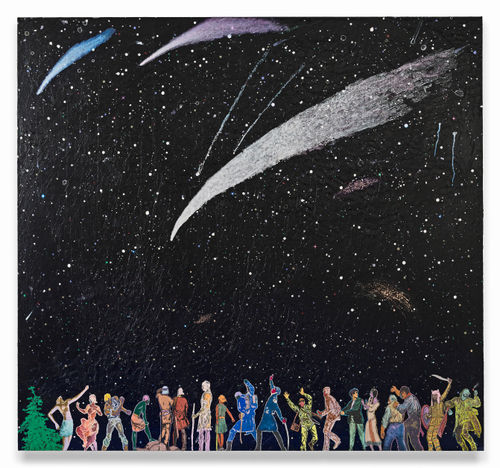
A fifth generation Westerner, Aaron Morse grew up in Arizona. His works explores a fascination not only with natural forms, but also with traces of human impact, sometimes obvious, sometimes hidden, always looming. Western spaces are dominated by an inescapable sense of geologic time, mind-bending dynamic forces at an outsized scale that slowly reveal how little we actually live to see in our short lives. The drama of those people and animals who pass through these landscapes on a smaller temporal scale are no less meaningful, but are properly measured against the vastness of the atmosphere. The exhibition, “Lights Out for the Territories,” includes works like, "Desert Mystery #2,” which places the viewer in the midst of action in medias res that might be happening all at once or in separate landscape timelines. "Night of the Comet" finds an odd group of people responding collectively and individually to a celestial occurrence of undetermined significance. Myths of the frontier, be it those of the American West or Outer Space, are also stories we use to explain to ourselves Gauguin questions (Where Do We Come From? What Are We? Where Are We Going?) "I like the iterative possibilities of new art and old ideas,” Morse comments. His work provides a stage for images and ideas - a means by which to think about how we make and respond to our representations - and how they figure in our lives.
Aaron MORSE (b. 1974, Tucson, AZ) received his BFA from the University of Arizona (Tucson, AZ) and his MFA from University of Cincinnati (Cincinnati, OH). Aaron Morse’s recent and upcoming solo and group exhibitions include, “Sea and Land,” Philip Martin Gallery (Los Angeles, CA); “If the Sky Were Orange: Art in the Time of Climate Change,” Blanton Museum of Art (Austin, TX); Hammer Museum (Los Angeles, CA); Berkeley Art Museum/Pacific Film Archive (Berkeley, CA); Santa Barbara Museum of Art (Santa Barbara, CA); Contemporary Arts Museum (Houston, TX); Nerman Museum of Contemporary Art (Overland Park, KS); Nora Eccles Harrison Museum of Art (Logan, UT); Weatherspoon Art Museum (Greensboro, NC); Frances Young Tang Teaching Museum and Art Gallery At Skidmore College (Saratoga Springs, NY). Aaron Morse is included in the Museum Collections of Berkeley Art Museum/Pacific Film Archive (Berkeley, CA); Santa Barbara Museum of Art (Santa Barbara, CA); Henry Art Gallery (Seattle, WA); Hammer Museum (Los Angeles, CA); Los Angeles County Museum of Art (Los Angeles, CA); Hilbert Museum of California Art (Orange, CA); Nora Eccles Harrison Museum of Art (Logan, UT); Nerman Museum of Contemporary Art (Overland Park, KS); Blanton Museum of Art (Austin, TX); Albright-Knox Art Gallery (Buffalo, NY); Museum of Modern Art (New York, NY); Whitney Museum of American Art (New York, NY); Rhode Island School of Design, (Providence, RI). Morse’s work has been reviewed in such publications as Los Angeles Times, Time Out, Flaunt, Tema Celeste, and Artweek. Aaron Morse lives and works in Los Angeles.
“Lights Out for the Territories” is on view January 24 - March 7, 2026, with an opening reception for the artist Saturday, January 24 from 5-8pm. Please join Aaron Morse for a Zoom webinar conversation on his work Friday, February 6 at 10am PST/ 1pm EST. Visit the news page of the gallery website for sign-up details.
Philip Martin Gallery is open Wednesday - Saturday from 11-5. For additional images, or information please email info@philipmartingallery.com, or call 323-507-2037. Philip Martin Gallery is located at 3342 Verdugo Road, Los Angeles, CA 90065.
